
Which Minmo Partner Fits the Way Your Business Operates?
From hosted wallets to connected payments, OTC, and escrow—choose the capabilities that fit your next business outcome.
 Minmo
Minmo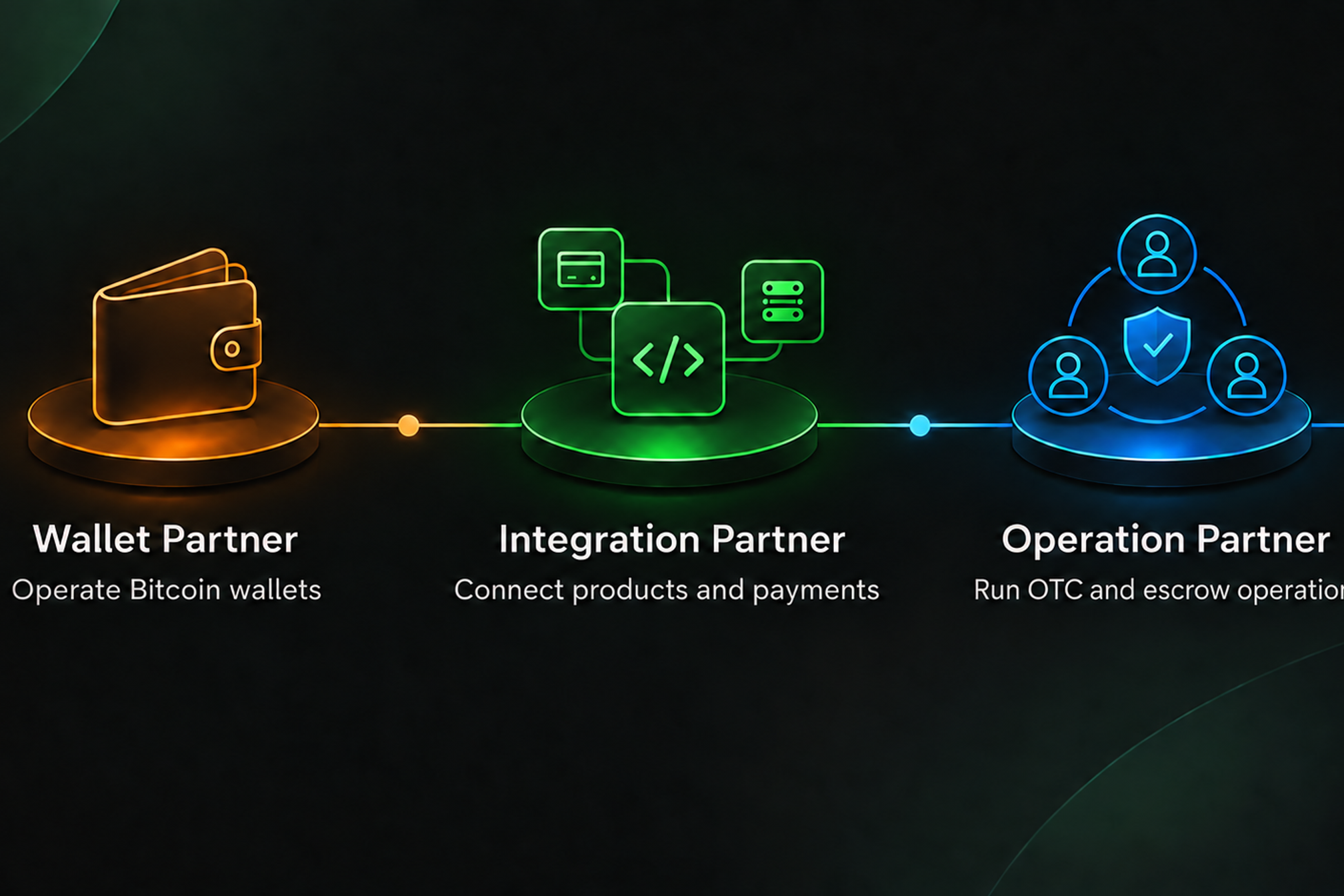
A business offering Bitcoin wallets has a different job from a business connecting an online store to Bitcoin payments. Both have different needs from an OTC desk coordinating agents, rates, swaps, and escrow.
Minmo has three Partner categories for these different operating models: Wallet Partner, Integration Partner, and Operation Partner. They are cumulative. Each category includes the capabilities of the one before it, then adds the tools needed for a broader job.
The right place to start is not the category with the longest feature list. It is the one that supports the next real outcome your business needs to deliver.
The three Partner categories at a glance
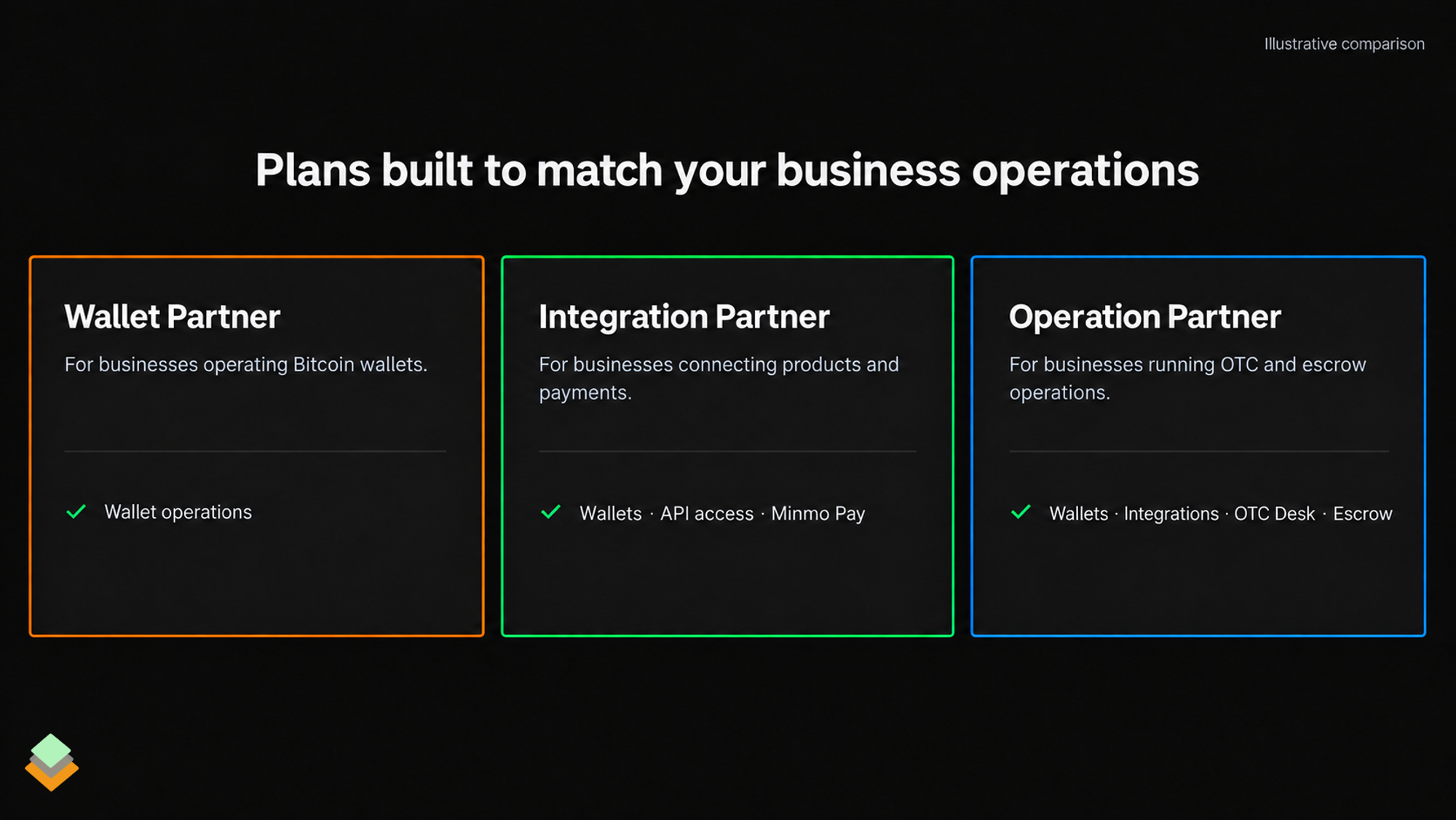
Access to a category is only one part of operating safely. Individual actions can still depend on the permissions assigned to your business, product configuration, resource ownership, and the readiness of the service in your market.
Wallet Partner
start with the wallet operation
Wallet Partner is for a business that needs hosted Bitcoin wallet infrastructure without yet needing a custom integration or a coordinated OTC desk.
Your business may need one Wallet for a specific service or several Wallet instances to keep different operational purposes separate. Each Partner Wallet has its own identity, balance, movement history, provider connection, and operating state. This gives the business a clear boundary for the Bitcoin it is responsible for.
A Partner Wallet is not the same as the self-custodial Agent Wallet in Minmo Mobile. The Partner Wallet supports the business's hosted operations. The Agent Wallet belongs to the agent's mobile experience. Keeping that distinction clear helps everyone understand who controls a wallet and what it is for.
Wallet Partner is a good starting point when your immediate need is to:
- create hosted Wallet instances for defined business purposes;
- send and receive Bitcoin through those Wallets;
- inspect balances and movement history; or
- establish the Wallet boundary that another service may use later.
You do not need to choose an integration or OTC operating model before the wallet job is clear. Start with the Wallet instances your business needs, who may use them, and how each one should be kept separate.
Integration Partner
connect Minmo to the systems you run
Integration Partner is for a business that needs more than a standalone wallet operation. It includes Wallet Partner capabilities and adds the controlled connection layer for Partner applications and Bitcoin payment workflows.
For an ecommerce business, that could mean using Minmo Pay to provision a BTCPay store, connect the Partner Wallet that receives payments, create Bitcoin checkout invoices, and read the authoritative invoice state. The customer uses a BTCPay-hosted checkout while the Partner's application keeps control of its catalog, orders, tax, shipping, and fulfilment decisions.
For a business building its own application, Integration Partner provides Partner-scoped API access. API keys must stay on a trusted server and carry only the permissions needed for the intended workflow. Selecting a Partner scope does not grant access by itself; the request must still pass the relevant permission and product checks.
Integration Partner is a good fit when your business needs to:
- accept Bitcoin payments through the supported Minmo Pay flow;
- connect a Partner Wallet to a product or backend system;
- automate an approved Partner workflow through the Minmo API; or
- give developers a bounded integration surface without exposing credentials in a browser or customer-facing application.
The useful milestone is not simply creating an API key. It is completing a working, supportable flow: a payment or operation can begin, reach an authoritative outcome, and be reconciled when something is unclear.
Integration access does not automatically add OTC Desk or Escrow. Those products have their own responsibilities because moving liquidity and holding funds for settlement require additional controls.
Operation Partner
coordinate the people and controls behind transactions
Operation Partner is for businesses running a local Bitcoin service rather than only a Wallet or payment connection. It includes Wallet and Integration Partner capabilities, then adds OTC Desk and Escrow.
OTC Desk brings together the work behind an on-ramp or off-ramp: agents, supported currencies and payment methods, rates, liquidity, quotes, swaps, payouts, and settlement. The Partner can organize this activity around its own operating model while agents serve customers in the markets and communities they know.
An agent's association with a Partner does not transfer ownership of the agent. Private agent configuration, credentials, payment details, and other agent-controlled information remain behind their proper boundaries. The Partner relationship provides the context needed for scoped discovery, activity, and operations; it is not a claim over the agent's identity or business.
Escrow adds a protected settlement boundary. It covers the lifecycle from funding and verification through release, refund, dispute handling, and recovery. Operating that lifecycle means defining who may take each action, preserving evidence when an outcome is uncertain, and keeping recovery paths available for funds that are already committed.
Operation Partner is a good fit when your business needs to:
- coordinate agents working within a Partner network;
- define currencies, rates, and responsibilities for an OTC service;
- monitor swaps, payouts, and settlement progress;
- operate protected escrow workflows; or
- handle disputes and ambiguous transaction outcomes through a defined process.
This category fits businesses prepared to own an operating process, not simply turn on more features. Before starting, define the markets you intend to serve, the roles in your business, the liquidity model, the settlement path, and who responds when a transaction does not follow the expected path.
Choose the smallest category that completes the job
Use the workflow—not the category name—as your guide:
- Do you need hosted Bitcoin Wallets for your business's services? Start with Wallet Partner.
- Do those Wallets need to connect to a checkout, application, or automated backend workflow? Consider Integration Partner.
- Will your business coordinate agents, rates, liquidity, swaps, or escrow? Operation Partner is designed for that operating responsibility.
A Wallet Partner can establish a useful wallet operation before integrating anything. An Integration Partner can prove a working payment flow before building a full OTC service. An Operation Partner can add coordinated workflows when the people, liquidity, controls, and support process are ready.
That progression matters. It lets your business add responsibility with purpose: first establish the wallet boundary, then connect it to the systems you run, then introduce the operational controls needed to serve customers through OTC and escrow.
Define your next outcome
Before choosing a Partner category, write down the next outcome your business needs to deliver. Name the Wallet, application, payment flow, agent operation, or settlement process involved. Then identify who controls it, what can go wrong, and what evidence your business will need when it does.
That gives you a better starting point than a list of features. It also gives Minmo enough context to review the relevant Partner model, product readiness, and implementation path with your business.