
Minmo In the Open
 Minmo
Minmo
Bitcoin Works. Access Does Not.
A trader in Nairobi is waiting three days for an exchange withdrawal right now. A business owner in Lagos is coordinating a swap in a Telegram group. A remittance worker in Buenos Aires is manually matching requests across chat apps.
The Bitcoin protocol settled in ten minutes. The access is taking days.
Bitcoin works. Blocks settle. Transactions confirm. Keys verify. Across continents and political systems, the protocol continues to operate exactly as designed.
Access does not.
In many parts of the world, converting local currency into Bitcoin still means navigating large centralised exchanges, heavy compliance flows, delayed withdrawals, fragile banking rails, and liquidity bottlenecks. This model concentrates power in a handful of global platforms and assumes financial infrastructure is something users must petition for access to.
It scales in capital markets. It does not scale in communities.
The bottleneck is not Bitcoin.
It is the access layer built around it.
Minmo exists to rebuild that layer, and we are building it in the open.
What We Learned in Kenya
Before we describe what we are building, here is what we have already seen.
Over the past six months, we ran focused pilots serving communities in Kenya. These were not controlled experiments. They were real coordination attempts in real communities, and they taught us things no whitepaper would have.
What we observed:
Trust compounds locally. An agent's reputation in their neighbourhood transferred to new users faster than any verification flow we designed. Reputation is social before it is technical.
One agent, one direction, one ceiling. Running a single pilot revealed demand that no single operator could serve alone. Scaling access requires a network, not just more agents doing the same thing.
Agents need operational tooling, not just market access. The barrier for most local operators was not finding users. It was managing the operational complexity of running exchange professionally and safely.
Settlement design determines confidence more than interface polish. Users cared less about interface design than about safety and whether swaps would reliably complete.
Access is not a feature. It is a system.
Systems must be designed with local realities in mind.
While these pilots were conducted in Kenya, the patterns we observed reflect broader dynamics across emerging Bitcoin markets in Latin America, Southeast Asia, and beyond.
The Missing Layer
Bitcoin solved the problem of verifying value without central authorities. What it did not solve is how communities coordinate the exchange between fiat and Bitcoin.
Today that coordination relies on:
- Centralised exchanges that assume identity, banking access, and compliance capacity most users do not have
- Fragmented peer-to-peer markets where liquidity fragments and reputation does not travel
- Informal trust networks operating through messaging apps and spreadsheets
Functional, but brittle.
What is missing is a coordination layer that allows communities to facilitate Bitcoin access professionally while remaining interoperable across the network.
Bitcoin removed the need for central banks to verify value. The next shift removes the need for centralised platforms to coordinate access.
Minmo is building that missing layer.
What Minmo Is Building
Minmo provides coordination infrastructure for community-based Bitcoin on and off ramps.
We do not custody funds.
We do not operate a marketplace.
Instead, we build infrastructure that allows trusted local agents to coordinate exchange professionally, transparently, and safely within their own communities.
At its core, Minmo provides:
- Swap coordination tooling
- Escrow and rule-based settlement modules that lock funds until agreed conditions are met
- Agent reputation and operational systems
- Embeddable APIs for applications integrating Bitcoin-fiat flows
A typical flow looks like this:
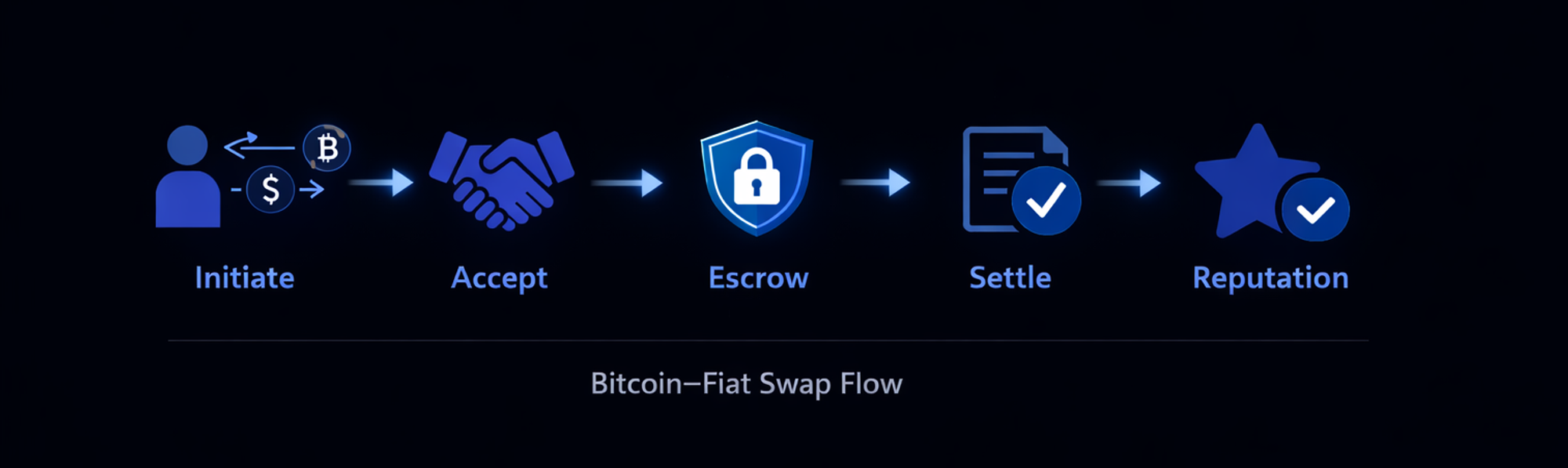
- A user initiates a swap request
- A local agent accepts
- Funds are locked in escrow until the agreed conditions are met
- Settlement confirms completion
- Reputation updates on both sides
Agents retain custody of their own liquidity. They operate within their local context. Minmo provides standards, coordination infrastructure, and trust signalling mechanisms that make peer-to-peer exchange safer and more scalable.
The goal is not to replace agents.
It is to make them stronger.
From Marketplaces to Networks
Most financial platforms are marketplaces. They intermediate, custody, control liquidity, and extract fees from the centre.
Minmo is building something different: an open agent network.
Most financial platforms are marketplaces.
Minmo is building a network
In this model, trust is local, liquidity is local, and coordination is shared. Agents operate independently but interoperate through common standards. Applications integrate without needing permission from a central operator. Reputation systems provide continuity across transactions.
Over time, Bitcoin access should not depend on which company you use. It should depend on shared protocols and open standards.
Minmo's role is not to own the network. It is to make it usable.
Why We Are Building in the Open
Access infrastructure should be inspectable. Communities should be able to audit the rules that coordinate their liquidity. Developers should be able to adapt tooling to local contexts. Agents should understand the systems they rely on.
Our approach:
- Core agent standards and coordination protocols are open
- Foundational modules and reference implementations are open to audit and contribution
- Minmo-operated services (hosted APIs, reliability layers, and managed infrastructure) are paid offerings.
This separation matters. Open standards ensure interoperability. Operated services ensure reliability and sustainability.
Open does not mean abandoning responsibility. It means competing on service quality, not on control of the network.
The coordination layer is shared. Execution is earned.
Join Us
There are three ways to engage with Minmo:
Community Pilots: If you are a community leader or operator, work with us to adapt Minmo's tooling to your local context.
Developers: Contribute to core modules, improve agent standards, or build applications that integrate Bitcoin-fiat exchange through Minmo's APIs.
Funders and Partners: If you believe Bitcoin access should not depend solely on centralised exchanges, support us in scaling an open, community-driven coordination layer.
Bitcoin does not need another exchange.
It needs better access.
The next person who needs liquidity shouldn't have to search a Telegram group to find it.
Access that is local.
Access that is resilient.
Access that communities can trust.
Minmo is building the coordination layer that makes that access possible.
And we are building it in the open.